

01 / THE QUESTION
Can AI assistants become
the new donation page?
Every nonprofit benchmark this year reports the same thing: organic search traffic is falling, and AI chatbots are the reason. This has sounded an alarm in the sector, but I actually believe that technology developing right now paints a different picture of the future.
Gifts and website visits are decoupling. Visits will keep falling. Gifts, from the same pool of searchers, can hold and then grow because the growth is arriving in a channel most nonprofits cannot yet see in their analytics: the conversation itself.
I will take you through four sequential blocks of thinking. What is measured. What we assume. What the forecast shows. I end with some recommended priorities.
02 / THE EVIDENCE
What we know
These are the measured facts. Everything later in the paper is built on them.
Search traffic to nonprofits is shrinking. Organic search was 39% of nonprofit website visits in 2025 and declined through the year; M+R attributes the fall to AI overviews, zero-click search and chatbot discovery.1 The monthly trajectory ran from 43% of visits in January to 26% in December.2
The web as a whole is losing search referrals. Page views from Google Search across Chartbeat’s publisher network fell 34% between December 2024 and December 2025. Chatbot referrals grew more than 200% in the same period but remain under 1% of page views.3 Publishers expect search referrals to fall a further 43% over three years.4
AI answers suppress clicks. When a Google AI Overview appears, users click a result 8% of the time, against 15% when it does not.5 Fewer than one in three Google searches now sends a click to the open web.6
Assistants cite more, and users click those citations rarely. Citations appeared in 1.6% of US ChatGPT prompts in June 2025 and 6.8% by May 2026.7 A displayed citation earns a click 5.8% of the time; transactional citations 8.6%, informational 3.6%.8 A server-log study found assistants fetching a page roughly 100 times for every visitor they sent.9
The visitors who do click convert unusually well. Adobe, tracking over a trillion US retail visits, reports AI-referred traffic converting 42% better than non-AI traffic by March 2026, with revenue per visit 37% higher; a year earlier it converted worse.10 Ruler Analytics, across 110 million sessions, puts AI referral conversion at 5.8%, above organic search and comparable to paid.11 The base is small: about 1% of website traffic.12
Nonprofit websites convert 1.6% of visitors into donors, at $1.33 per visitor.13
03 / THE MODEL
The assumptions,
in plain terms
The forecast indexes gifts from two channels, organic search and AI assistants, to 100 in 2025. Every other channel is excluded and held constant. Each assumption below is graded with a confidence score.
| Assumption | Value | Basis | Confidence |
|---|---|---|---|
| Organic search visits | Fall 25% a year | M+R shows the decline under way; publishers expect −43% over three years | Measured trend |
| AI assistant referral visits | Grow 3×, 2×, 1.5× a year from a 1% base | Citation rates quadrupled in a year; clickable brand links lifted ChatGPT referrals 158% in one week | Measured trend |
| Website conversion, search visitors | 1.6% donate | M+R site-wide average; conversion by channel is not published | Assumed |
| Website conversion, AI-referred visitors | 4.0% donate (2.5× search) | Premium measured in retail (Adobe, Ruler); not yet measured for giving | Assumed |
| In-chat gifts | Pilot 2027; 2028 at 1.5× AI-referral gifts | Requires a charity category in a commerce protocol and the nonprofit as merchant of record | Speculative |
| All other channels | Constant | Email, direct, paid and social are outside the model | Scope |
Two points on the weakest of the data foundations. The AI conversion premium is transplanted from commerce. The mechanism, that the conversation qualifies the visitor before the click, has no obvious reason to fail for giving; a donation is a more decided act than a purchase. But it is untested. And the in-chat segment depends on decisions the platforms have not yet made. It is the upside case.
04 / LOOKING AHEAD
The forecast
Gifts from search and AI channels
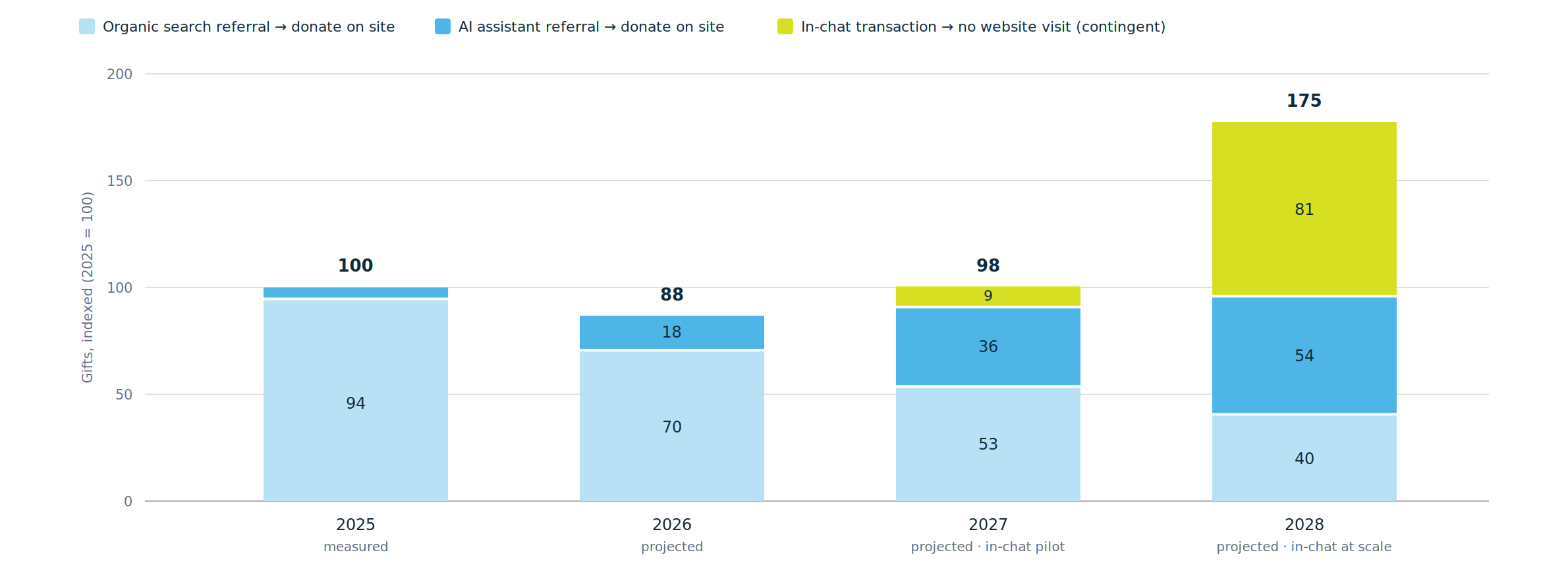
Read the forecast values
| Channel | 2025 | 2026 | 2027 | 2028 |
|---|---|---|---|---|
| Organic search → on-site gift | 94 | 70 | 53 | 40 |
| AI referral → on-site gift | 6 | 18 | 36 | 54 |
| In-chat gift · contingent | 0 | 0 | 9 | 81 |
| Total | 100 | 88 | 98 | 175 |
2025 is the indexed baseline; 2026–2028 are projections. Values are rounded as displayed in the source.
This figure of the forecast illustrates the case for optimism. You can see that organic search continues to decline, while AI referrals increase, and ultimately in-chat donations start to drive a lot of the giving. Some detail below.
Three things are visible.
Gifts hold flat while visits fall. Total website visits in the model drop 14% by 2028. Gifts from the same two channels finish 2027 at 98. The conversion premium on AI referrals offsets almost all of the volume loss, because a search click was always a weak signal and an assistant click is a strong one.
The growth arrives without a visit. By 2028, in the base scenario, in-chat gifts are the largest source, larger than organic search ever was. None of them appears in website analytics.
The website changes job. It stops being the destination and becomes the source: the place assistants read to decide whether to recommend you, and the checkout they hand off to.
The scenario is deliberately moderate. A steeper search decline with a larger conversion premium, which is what M+R’s monthly data and the log studies suggest, produces a higher total by 2028, not a lower one.
05 / THE CHANGING WORK
Three channels,
three jobs
Organic search: shrinking,
and changing purpose
Search is not dying; Google’s search revenue grew 19% in the first quarter of 2026. What is dying is the click. Google now answers, calls businesses on the user’s behalf, and is building a cart that completes purchases without a site visit.
Google’s “Have AI check pricing” feature calls local businesses ranked in the map pack, gathers quotes and emails the user a comparison; businesses that do not answer are listed as unreachable.14 Universal Cart, announced at I/O in May 2026, completes purchases inside Google’s surfaces with the seller remaining merchant of record.15
The job is no longer to rank. It is to be read correctly and cited. Answer engine optimisation is the practical expression of that:
- A direct answer in the first paragraph of every key page. What you do, for whom, where, with what result.
- Documented impact numbers. Assistants quote specifics and skip vague claims.
- Registry hygiene. Identical legal name, registration number, founding date and mission across your site, Candid, Charity Navigator and Google Business Profile. Assistants recommend what they can corroborate.
- Structured data. Schema markup for organisation, campaigns and donation actions.
- A phone that gets answered. When an assistant calls to check what you do (silence is disqualification.)
AI assistant referral: growing,
and worth more per visit
Two tasks. Be cited, then be worth the click.
Being cited is the search job above. Being worth the click means treating an AI-referred visitor as what they are: someone who has already decided. The landing page should confirm and convert, not persuade. And the channel must be visible: tag ChatGPT, Claude, Gemini and Perplexity as a referrer group in analytics, or the growth in Figure 1 will show up as unexplained direct traffic.
Beyond the page, there is the door. An MCP server is a small hosted service that lets assistants query a nonprofit directly: current campaigns, documented impact, designations, a giving link. It is opt-in, not crawled; assistants connect through directories and the MCP Registry, which remains in preview.16 Benevity already runs one, exposing 2.4 million verified nonprofits to Claude for discovery, with donations linking out to each organisation’s site.17 Figure 2 shows what this looks like.
An agent-answerable nonprofit
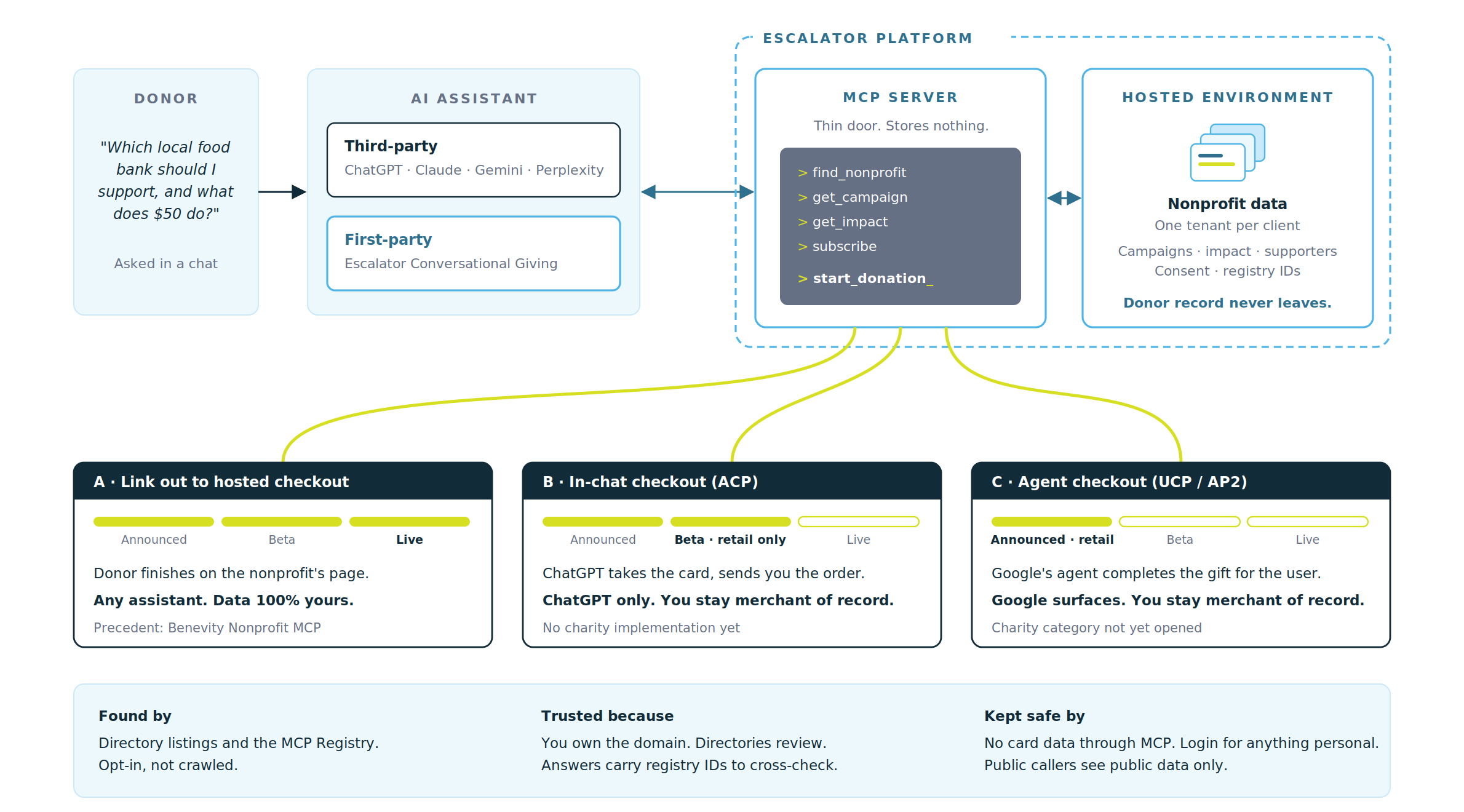
Read the diagram in words
The question: A donor asks, “Which local food bank should I support, and what does $50 do?”
The assistant: A third-party assistant (ChatGPT, Claude, Gemini or Perplexity) or first-party Escalator Conversational Giving queries the nonprofit’s platform.
The connection: An MCP server is the thin door into the platform. It stores nothing and exposes operations to find a nonprofit, get a campaign, get impact information, subscribe, or start a donation. It connects to a hosted environment with a separate tenant per client, containing campaigns, impact, supporters, consent and registry IDs. The diagram states that the donor record never leaves.
- Link out to hosted checkout: the donor finishes on the nonprofit’s page. Any assistant can use it. The source marks this as live and cites Benevity Nonprofit MCP as a precedent.
- In-chat checkout (ACP): ChatGPT takes the card and sends the order to the nonprofit, which remains merchant of record. The source marks this as retail beta, with no charity implementation yet.
- Agent checkout (UCP / AP2): Google’s agent completes the gift; the nonprofit remains merchant of record. The source marks this as announced for retail, with the charity category not yet opened.
Discovery and trust: directory listings and the MCP Registry; opt-in connection rather than crawling; an owned domain, directory review and registry IDs to cross-check answers.
Safety boundaries: no card data through MCP, sign-in for personal information, and public data only for public callers.
Readiness labels reproduce the August 2026 source diagram.
In-chat transactions: contingent,
and the largest prize
Nothing here is live for charities. OpenAI launched in-chat checkout in September 2025 and scaled it back in March 2026, moving to discovery in chat and transaction on the merchant’s site.18 Google, Perplexity and Amazon are still building embedded checkout. All three card networks now support agent-initiated purchases.19 Fundraise Up has named “agentic giving” as a category without naming a product or a date.20
The job now is readiness and influence. Readiness means having the front door built so that the week a charity category opens in a commerce protocol, you can plug in. Influence means the sector saying that giving inside an assistant must keep the nonprofit as merchant of record and deliver the donor record with the gift. That is the difference between the two futures of the yellow segment.
06 / THE PRIORITIES
How to live
in the new world
Everything in the first two stages pays off whether or not in-chat giving arrives. They improve citation and conversion today. The third stage is a bet.
Now
0–6 monthsRegistry hygiene. Rewrite key pages for direct answers and documented impact. Tag AI referrers in analytics. Make sure the phone is answered.
Raises citation and search performance immediately; costs little.
Next
6–18 monthsPublish an agent front door (MCP or equivalent) exposing identity, campaigns, impact, FAQ and a hosted giving link. Deploy conversational giving on channels you own: email, web, SMS, WhatsApp. Set up a voice agent for AI-initiated calls.
Converts the visitors who come; the owned channels are where a nonprofit can still initiate.
Then
18–24 months+Implement protocol checkout (ACP, UCP) when a charity category opens, keeping merchant-of-record status. Pilot apps inside assistants.
Optionality on the largest segment; worthless without the first two stages.
07 / TESTING THE THESIS
What would change
our mind
Three findings would break the forecast.
AI-referred donors converting no better than search visitors. The flat line in 2026–27 would become a falling one.
Assistants routing gifts through funds by default. The yellow segment would grow, and the supporter file would not.
Citation click-through stalling below 5% while citation rates plateau. The blue segment would stop growing before it mattered.
None has happened yet. All three are measurable within a year. We will report which way they go.
SOURCES & FURTHER READING
References
The 20 references from the original August 2026 whitepaper. Select a source to open its linked publication, or use the return arrow to go back to its citation.
- M+R Benchmarks 2026, Website Performance.↩
- Donorbox, “Agentic Giving,” August 2026, citing M+R Benchmarks 2026.↩
- Axios, “Small publishers hit hardest by search traffic declines,” 17 March 2026, reporting Chartbeat data.↩
- Reuters Institute, Journalism, Media and Technology Trends and Predictions 2026 (survey of 280 media leaders in 51 countries), January 2026.↩
- Pew Research Center, July 2025, analysis of 68,879 searches.↩
- SparkToro / Similarweb, 2026.↩
- Similarweb, “AI Search Stats in 2026.”↩
- Focus Digital, “AI CTR by LLM, Industry, and Query Type,” 2026.↩
- Clickport, “AI Citations vs Clicks,” July 2026 (two sites, 14 days, IP-verified fetches).↩
- Adobe Digital Insights, 2026, as reported by Elogic, “ChatGPT Commerce & Agentic Shopping Statistics 2026.”↩
- Ruler Analytics, “Conversion Rate Benchmarks 2026.”↩
- Conductor, 2026, as reported by Demand Local.↩
- M+R Benchmarks 2026, Website Performance.↩
- Google Search Help, “How to check pricing for local businesses with AI in Google Search.”↩
- Search Engine Land, “Why agentic commerce will matter more than ChatGPT ads,” July 2026.↩
- The official MCP Registry provides namespace verification and standardised server metadata but does not certify content; as of July 2026 it is in preview. Digital Thought Disruption.↩
- Benevity, “Anthropic x Benevity,” December 2025.↩
- Hypotenuse, “ChatGPT Instant Checkout: What Happened to It in 2026,” August 2026.↩
- Paz.ai, “Agentic Commerce in 2026,” August 2026.↩
- Fundraise Up, “Fundraise Up Introduces Agentic Giving,” PR Newswire, 30 July 2026.↩
Read. Reflect. Revisit.
The original whitepaper and its accompanying presentation.